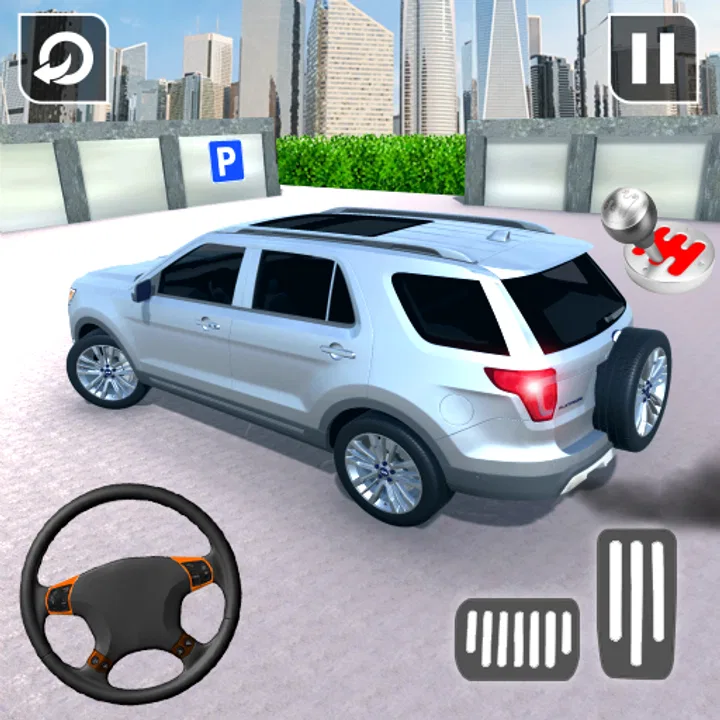
Prado Parking Game: Car Games
- 4.3
- Rating
- 10.00M
- Installs
- Free
- Price
 Analysis by App-foxy
I spent time with Prado Parking Game: Car Games as a short-session driving challenge, and my first impression was clear: this is less about racing to the finish and more about making careful choices with a large vehicle in tight spaces. That distinction matters. If you want speed, traffic, or an open road to explore, this may feel limited. If you enjoy the small satisfaction of lining up a vehicle, correcting a mistake, and finally reaching a marked parking area cleanly, it has a straightforward appeal.
This is a free role-playing game from Zamsolutions, although its role-playing label is best understood loosely. The main experience is built around driving and parking rather than character development or a long narrative. It is aimed at Everyone, which makes it approachable for younger players and casual users, while the controls and precision requirements still give adults a reason to return for a few attempts. The game has been available since March 17, 2019, and its current version is 1.7.48.
How the parking decisions shape each attempt
The interesting part of a parking game is rarely the destination itself. It is the sequence of decisions made before reaching it. I found myself thinking about entry angle, turning space, and how much room remained on either side of the vehicle. A careless approach can make the final alignment harder than it needs to be, while a slower setup often turns the same parking task into a manageable one.
You May Also Like

 Blood Strike: 2.5 Anniversary
Blood Strike’s Loadouts Turn Every Drop Into a Tactical Gamble
A close look at Blood Strike’s custom loadouts: how fast access to signature weapons reshapes its battle royale rhythm, rewards preparation, and narrows the gap between fights.

 Pandora - Music & Podcasts
Pandora’s Music Is Easy to Start, but Harder to Recover
Pandora’s strength is its low-effort path from a seed to a station. Its weak spot is how much confidence it asks you to place in connection, setup, and quiet recovery.

 8 Ball Pool
 Is Built on Rivalries, Rematches, and Routine
A close look at the rivalries, rematches, shared routines, and unanswered safety questions that turn a quick pool match into a persistent mobile community.

 Samsung Music
’s Quiet Strength Is Playing What You Already Own
Its reach comes less from spectacle than from dependable access to a personal library. That simplicity is both the app’s strongest retention engine and its ceiling.

 AccuWeather: Weather Radar
AccuWeather Review: A Quick, Clear Forecast for Everyday Decisions
For everyday plans, the best forecast is the one you can understand quickly. AccuWeather makes rain timing, radar, and local conditions easy to act on, with a few trade-offs.

 Hill Climb Racing
Why Hill Climb Racing Still Turns Crashes Into One More Run
A tiny car, a bumpy hill and one more upgrade: Hill Climb Racing keeps resurfacing because its simple chaos makes every near-miss feel personal.
More From Our News Desk
View All News


That gives the game a different rhythm from ordinary driving games. The useful question is not simply “Can I get there?” but “What position should I create before I make the final turn?” When the vehicle is pointed badly, reversing may be wiser than forcing a correction. That is a small but important lesson in this kind of simulator: progress is sometimes achieved by giving up ground and rebuilding the approach.
I recommend treating each attempt as a planning exercise rather than immediately chasing speed. On a first pass, I look at the available route and identify the widest section for turning. I then decide whether to approach the parking area directly or leave myself a little more room for adjustment. This habit reduces rushed steering and makes the game feel more deliberate.
The Prado theme also affects the decision space. A large SUV-style vehicle does not feel as forgiving as a tiny city car would. Even without complicated systems, the sense of managing a bigger body changes how I judge corners. I have to leave more clearance, avoid sharp last-second movements, and think about the vehicle’s rear section instead of focusing only on the front.
That is where the game works best for me. It turns ordinary movement into a problem of positioning. A player who enjoys planning several seconds ahead will probably get more from it than someone who wants constant action. The challenge comes from controlling momentum and direction, not from defeating opponents or collecting a large amount of equipment.
Why slow inputs are often the better inputs
My most useful adjustment was to stop treating the steering as an on-off command. Short, measured inputs gave me more control than holding a direction for too long. When I made a wide correction, I often created a second problem on the opposite side of the vehicle. Gentle changes were less dramatic, but they produced cleaner parking attempts.
I also found it helpful to separate the approach into stages. First, I place the vehicle near the correct side of the route. Next, I straighten it before entering the final area. Only then do I focus on the parking position. Trying to solve all three tasks at once usually leads to unnecessary corrections.
This workflow is especially useful during a quick everyday session. If I have only a few minutes while waiting for an appointment, I can play one or two attempts without needing to remember a story or manage a large inventory. The session has a clear beginning and end: choose the route, make the approach, and see whether the parking is clean enough.
Risk, reward, and the cost of rushing
The central trade-off is simple: speed saves time, but caution protects the attempt. A fast approach may look efficient when the route is open, yet it leaves less room to react when the parking area demands a sharper adjustment. I usually prefer to sacrifice a little pace early if it gives me a straighter final entry.
That does not mean crawling through every section. Excessive caution can create its own frustration, particularly when a route gives enough room for a confident turn. The better balance is to move steadily in open space and slow down before the parts that require precision. In practice, I divide the route into low-risk movement and high-risk positioning rather than using one speed everywhere.
The strongest reward is not speed; it is preserving control until the final alignment. That may sound modest, but it changes how I judge success. A quick attempt that ends in a poor position teaches me less than a slower attempt that reveals exactly where my approach went wrong.
There is also a useful distinction between a visible mistake and a recoverable one. If the vehicle is slightly off-center, a small correction may be enough. If the angle is fundamentally wrong, continuing forward often makes the situation worse. I learned to recognize the point where reversing is no longer a failure but the correct strategic choice.
This is one of the non-obvious strengths of the game: it encourages players to evaluate a situation instead of reacting emotionally. After a mistake, the productive response is to ask whether the vehicle still has a workable angle. If it does, correct gently. If it does not, reset the approach before the error grows.
Adapting instead of repeating the same mistake
Parking challenges can become repetitive when every attempt is handled in exactly the same way. I got better results by changing one variable at a time. If I entered too sharply, I tried a wider approach on the next attempt. If I reached the area correctly but struggled with the final position, I focused on straightening earlier rather than turning harder at the end.
This makes the game more useful as a practice tool than as a simple test of reflexes. Each failed attempt can answer a specific question: Was the route chosen poorly? Did I begin the turn too late? Did I overcorrect? Was I moving too quickly for the available space? When I treated those questions separately, improvement felt more consistent.
I would not recommend restarting immediately after every small error. Sometimes continuing shows whether the mistake is actually fatal. That approach helps distinguish a genuine obstacle from a slightly untidy line. On the other hand, if the vehicle is trapped in an awkward orientation, repeated corrections may waste time. A fresh attempt can be more informative than a long struggle.
Players who are new to driving games may appreciate this gradual learning curve, but they should expect a little patience at the beginning. The controls may feel simple, yet simple controls do not automatically make precise parking easy. The challenge is in coordinating direction, speed, and vehicle position rather than learning a large set of buttons.
For younger players, I think the game works best when an adult frames mistakes as part of the process rather than as a reason to rush. The Everyone rating makes it accessible, but the precision element can still test patience. Short sessions and a focus on one improvement at a time are more enjoyable than demanding a perfect result immediately.
What keeps the experience useful over time
The long-term appeal depends heavily on whether you enjoy repetition with refinement. This is not the kind of game I would choose for a dramatic story arc or a constantly changing world. Its depth comes from improving the way I approach parking situations, not from discovering a complicated character system.
That makes it a good companion for players who like mastery in small steps. I can return after a break and still have a clear goal: use fewer corrections, choose a better line, or finish with more control. The experience rewards attention, but it does not require a long uninterrupted commitment.
At the same time, I understand why some players may lose interest. Once the basic driving pattern feels familiar, the experience can seem narrow compared with broader driving games. A racing title offers competition and speed; an open-world driving game offers roaming and variety; a deeper role-playing game offers characters, equipment, and progression systems. Prado Parking sits apart from all three by concentrating on the parking task.
That narrow focus is both its identity and its limitation. I would choose it when I want a contained challenge, not when I want a complete driving lifestyle. If you are comparing it with a racing game, do not expect the same excitement. If you are comparing it with a large role-playing game, do not expect the same sense of world-building. Its value comes from making a small activity precise and repeatable.
The free entry point helps with that decision. You can try the core experience without paying upfront, while optional in-app purchases range from $0.99 to $9.99 per item. I would approach those purchases carefully and first decide whether the basic parking loop holds my attention. For a casual player, the free version is the sensible starting point; spending only makes sense if the game has already earned regular space on your phone.
It is also worth considering the device requirement. The game supports Android 7.0 and later, so users with older phones should check compatibility before planning around it. On a supported device, I would still keep expectations realistic: this is a focused parking game, not a substitute for a full console-style driving simulator.
Where it fits in a real daily routine
I see two especially practical use cases. The first is a short break when I want something interactive but not mentally overwhelming. I can make a few attempts, stop after a successful parking sequence, and return to whatever I was doing. The second is casual practice for someone who likes vehicle positioning and wants a game that rewards patience more than rapid tapping.
It can also work as a shared challenge between family members. One person can attempt a route while another watches the approach and suggests leaving more room or starting the turn earlier. Because the objective is easy to understand, a non-player can follow the action without learning a complicated rule set. That makes it more approachable than many competitive games.
However, I would skip it if your priority is online competition, a story-driven campaign, or a wide selection of vehicles and activities. I would also avoid recommending it to someone who dislikes repeating a maneuver after a mistake. Parking games naturally ask for retries, and the enjoyment comes from refining the attempt rather than constantly moving to a new type of action.
Another trade-off is attention. The game is casual in format, but careful parking still needs concentration. It is not ideal for playing while distracted or while multitasking. A few seconds of inattention can change the vehicle’s angle enough to require a full correction. I prefer to play it when I can give the screen a focused minute or two.
My strategy for getting more from each session
My first tip is to preview the route mentally before committing to the final turn. I look for the point where the vehicle has the most room to change direction, then aim to arrive there in a stable position. This is more reliable than waiting until the parking area is directly in front of me.
My second tip is to use the rear of the vehicle as a reference. The front may appear clear while the back swings toward an obstacle or boundary. Thinking about the whole vehicle prevents the common mistake of steering based only on the nose. This is particularly important when making a tight turn.
My third tip is to preserve a recovery option. I try not to drive so close to an edge that one small error leaves no room to correct. Leaving a little space may make the route look less direct, but it creates flexibility. That extra room is often more valuable than a few seconds saved.
Finally, I recommend changing only one part of the plan after a failed attempt. If I alter speed, steering, route, and stopping point all at once, I cannot tell what helped. A controlled adjustment turns repetition into learning. This is the kind of small discipline that gives the game more depth than its short description suggests.
My verdict on the driving challenge
After playing it, I see Prado Parking Game: Car Games as a focused choice for people who enjoy careful vehicle control and short, self-contained challenges. The developer, Zamsolutions, keeps the concept easy to understand: place the Prado correctly, manage the approach, and avoid turning a small error into a larger one. The game has reached over ten million installs and holds a 4.4 average from around twenty-two thousand ratings, which fits its accessible, pick-up-and-play nature.
Those figures do not change my main advice: try it for the parking loop itself, not for the promise of a broad role-playing adventure. The game is strongest when I slow down, plan the entry, and treat each attempt as a decision problem. It is weaker for players who need constant novelty, competition, or a detailed progression system.
For me, the best way to approach it is as a free practice-oriented driving game. Start without spending money, play in short focused sessions, and judge it by whether improving your parking line feels satisfying. If you enjoy turning awkward angles into clean finishes, it can become a pleasant routine. If you want speed, exploration, or a richer simulated world, another driving category will probably suit you better.
Overall, I would recommend it to a friend who likes patient challenges and wants something simple enough to understand immediately but precise enough to reward better decisions. It is not a grand driving adventure, but it makes parking itself the strategy.
FAQs for Prado Parking Game: Car Games
01What is the main objective of Prado Parking Game: Car Games?
Prado Parking Game: Car Games is designed to test your precision and control while parking a variety of luxury Prado vehicles. The main objective is to complete challenging parking tasks in different environments, enhancing your driving skills without hitting obstacles. It’s a perfect game for those who enjoy realistic driving simulations with a focus on parking.
02Does Prado Parking Game: Car Games offer different difficulty levels?
Yes, the game offers multiple difficulty levels to cater to both beginners and experienced players. As you progress, the challenges become more complex, requiring greater precision and skill. This progression keeps the gameplay engaging and ensures that players can continuously improve their parking abilities.
03Are there in-app purchases in Prado Parking Game: Car Games?
Prado Parking Game: Car Games includes in-app purchases that allow players to unlock additional vehicles, environments, and customization options. While the game can be played without spending money, these purchases can enhance the gaming experience by providing more variety and personalization options.
04Can Prado Parking Game: Car Games be played offline?
Yes, one of the advantages of Prado Parking Game: Car Games is that it can be played offline. This makes it a great option for users who want to enjoy the game without needing a constant internet connection, perfect for on-the-go or in areas with limited connectivity.
05What are the system requirements for Prado Parking Game: Car Games on Android and iOS?
For Android devices, the game typically requires Android 5.0 and up, while iOS devices need iOS 10.0 or later. It’s always a good idea to check the specific requirements on the app store to ensure compatibility with your device, ensuring a smooth and enjoyable gaming experience.
Pros
- Realistic graphics enhance the driving experience.
- Wide variety of cars to choose from.
- Challenging parking levels keep gameplay engaging.
- Smooth controls make navigation intuitive.
- Frequent updates add new levels and features.
Cons
- In-app ads can be disruptive to gameplay.
- Limited customization options for vehicles.
- Some levels can be overly difficult.
- Occasional bugs may affect performance.
- Requires internet connection for certain features.

Prado Parking Game: Car Games
Gallery